
Harmonic Numerology
Understanding Numbers Beyond Their Digital Root
Harmonic Numerology is an esoteric approach to understanding the frequencies held in numbers through their compound forms, completed cycles, place values, and digital roots. Root numbers are important, but a number does not stop moving when it reaches its root — this is only the beginning of the resonance contained in a harmonic chord. As Albert Einstein famously said, “Energy cannot be created or destroyed; it can only be changed from one form to another.”
First, to understand the concept, I'm going to introduce you to how numbers are commonly reduced in Numerology — digit summing. Digit summing is a method of reducing a number by adding its individual digits until you reach a smaller number, or digital root. A digital root is what we arrive at when we continue that process until the number is reduced to a single digit between 1 and 9.
For this example, I've used the compound number 1992. Let's start then by adding each single digit:
1 + 9 + 9 + 2 = 21
Here, 21 is the digit sum of 1992. To find the digital root, we continue summing the single digits:
2 + 1 = 3;
The final result is
3.
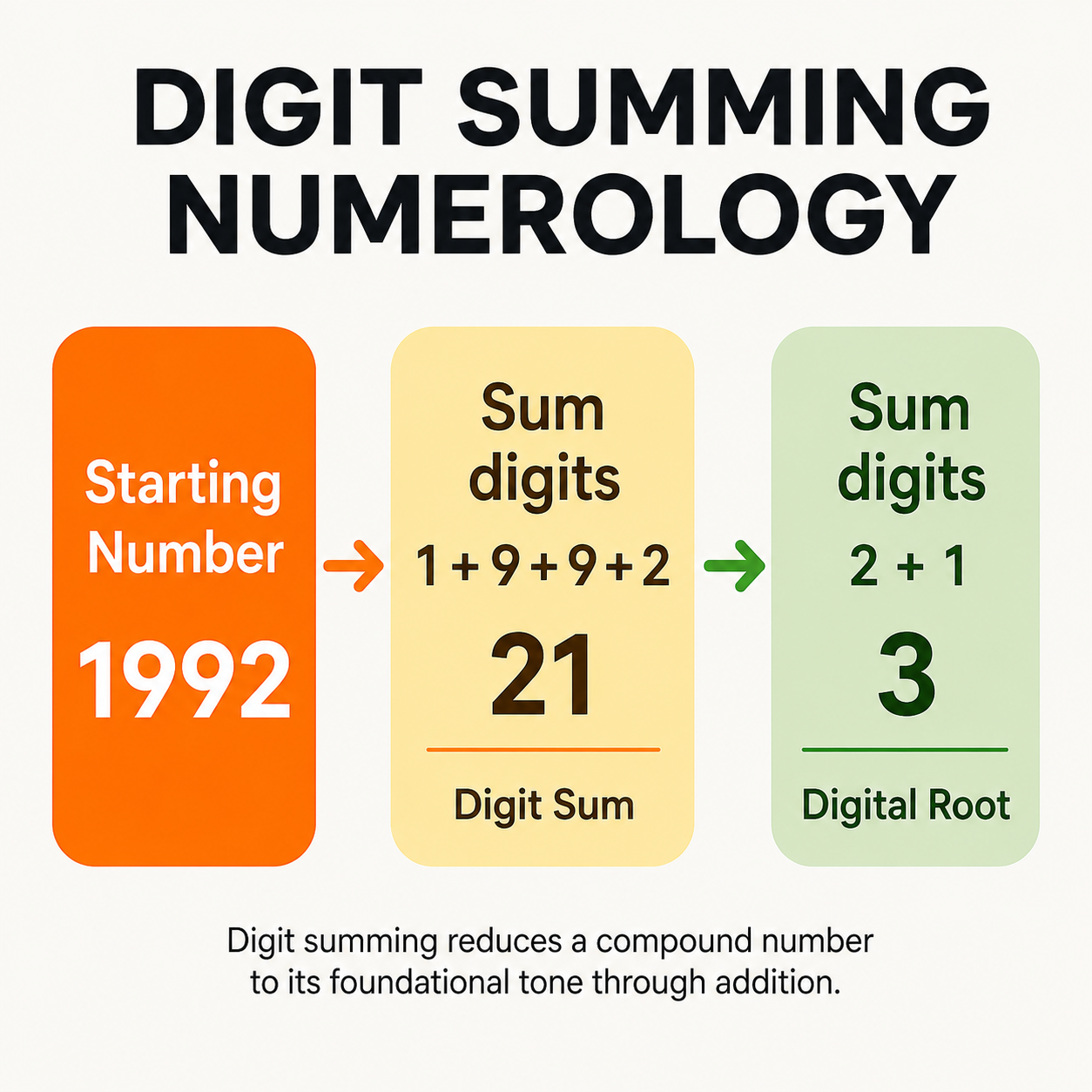
In modern Numerology calculators, this process would be written as 21/3 because the calculation produces two distinct results: 21 is the digit sum, and 3 is the digital root derived from that sum. The slash shows the relationship between the digit sum and the digital root: 21 is the compound number produced by the first calculation, while 3 is the single-digit root reached by continuing the reduction through base-10 mathematics.
This method is useful for identifying the root frequency of a number. Harmonic Numerology, however, does not stop at the root.
Imagine that all the single digits are seeds that never stopped growing.
1, 2, 3, 4, 5, 6, 7, 8, and 9 are not isolated points that we bring everything back to. They are foundational frequencies that can develop, combine, repeat, and move through different stages of completion to create larger numerical tones.
Digit summing is designed to identify the base tone underneath a greater numerical rhythm. It was never meant to describe the full developmental process that stems from the base.
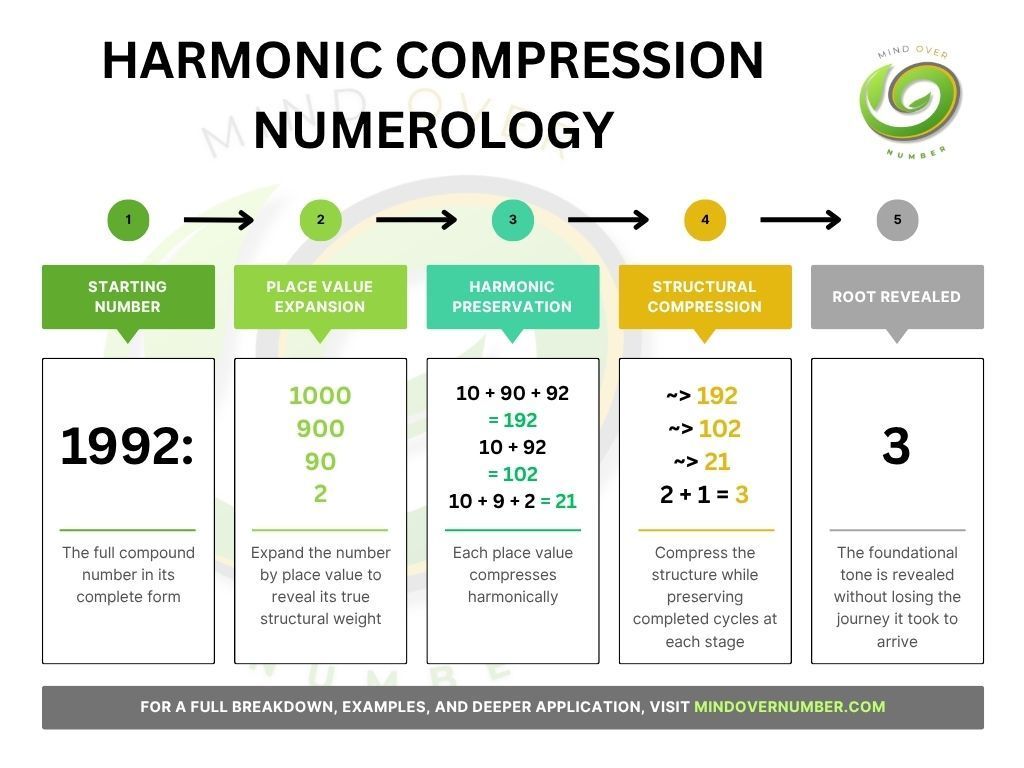
1 + 9 + 9 + 2 = 21/3, but 1992 fully expresses as; 1,000 + 900 + 90 + 2
The two 9s may look identical when separated from their cycles, but they don't represent the same energetic value within 1992. One represents 900. The other represents 90.
Their position changes their contribution to the whole.
Harmonic Compression doesn't break a frequency down until only its digital root remains. In a sense, it folds the frequency inward, preserving the structure and layers of the original number as it compresses.